
FocusOn – Global Insights. Features reports on the Industry’s developing technology as well as interviews with the top executives of manufacturers and end users of equipment for the industries served by FocusOn publications.
In this edition, Roger Murrow reports on: New crushing technology leads to new source of aggregates
Excavated rock from tunnel excavations has been used as ballast for railways, rock for flood defenses, roads and landscaping to name but a few applications. However, the use of the rock as aggregates for construction has always seemed to be the most obvious, but lack of expertise, firm regulations from government and lack of knowledge concerning specialist equipment have held back the use. Now however this has changed with state of the art equipment together with ‘out of the box’ thinking increasingly seeing rock from tunnel excavation being used as primary aggregate.

Major European tunnel project
One such application where aggregates are being produced is the Semmering Base Tunnel. This scheme is part of the huge Trans-European high-speed railway project, which runs from Gdynia, Poland, and ends in Ravenna, Italy. Due to the mountain areas, several long tunnels are being dug, especially in Austria. Here twin tunnels with a total length of 27.3 kilometers, are being bored by ARGE Tunnel Fröschschnitzgraben, a joint venture between Implenia and Swietelsky Tunnelbau.
The new tunnel, together with Koralmbahn, will shorten the travel time between Vienna and Klagenfurt from four hours to less than two and a half hours. The contract of the joint venture is the middle tunnel section, 24 km in length. Because of the varying rock conditions, it was decided to start the project from the middle of the tunnel by boring two 400-meter-deep shafts. After completing the shafts and caverns in March 2017, the tunneling work started in both directions in March 2017. The tunnel is seven meters wide and ten meters high. In addition, a 25-meter-wide and17 meter high rescue tunnel is being bored. All the blasted materials are lifted through the shaft.

Getting a crusher down a tunnel
A major part of the project called for crushing on site in order to produce aggregates at source. This actually meant getting a crusher down a tunnel! This of course proved problematic but Metso rose to the challenge by engineering and building the world’s first split LT106E tracked jaw crusher. This is now crushing at full speed the rocks extracted from the Semmering Base Tunnel.
The Metso crusher is fully electrically driven, and is split into parts no longer than seven meters for lowering. Additionally, the constant crushing capacity has to be 300 tons per hour in order to meet crushing demand. The disassembly, lowering and re-assembly in the tunnel have gone well, with the unit proving itself reliable and powerful enough to meet capacity requirements.
Following primary crushing at source, the rock is temporarily stored underground in hoppers. Two elevators with a combined capacity of 800 tons per hour take the material to the surface. At the surface, the aggregates are transported with static conveyors 2.9 km away for filling.
Norwegian road tunnels

Norwegian cement and concrete manufacturer Ølen Betong AS is now one of the biggest manufacturers of Ready-Mix concrete, precast elements and concrete products in the country. The company through its subsidiary Nor Aggregates is also a major producer of aggregates, both for its own use in concrete and cement manufacturing, and for supply to the Norwegian construction industry. One of the major sources of material is now tunnel excavations which are being reused for a variety of applications on the tunnels themselves.
Investment in tunneling
In recent years Norway has seen a large amount of road and tunnel construction in order to improve links between communities, and effectively straightening major highways. One of the most ambitious projects to date was the Ryfast project which included the driving of the new 14.3km Ryfylke or Solbakk twin road tunnels and will also involve the construction of 53km of new roads. The twin road tunnel will, when completed, be the world’s longest and deepest undersea road tunnel, with Ølen Betong having supplied a staggering 340,000m3 of concrete for the tunnel linings, with much of the material being derived from excavated tunnel rock.

An even more ambitious program of tunneling is due to extend the E39 main road north of Stavanger via several other islands heading towards Bergen, Norway’s second largest city. This will include an even longer undersea tunnel section – the Rogfast tunnel – which started in 2015 and aims to be completed by 2022.
Processing the material
Ølen Betong has played an important role in ensuring the success of the tunneling operations in providing the shotcrete for the tunnel linings, as well as increasingly providing aggregates for the highways, with the latter work especially having gone to a large extent unheralded. What is unique has been the source of the material used; although a great deal has come from traditional sources (including Ølen Betong’s own granite quarries) much has resulted from the newly developed crushing and screening techniques developed by Ølen Betong in partnership with contractors in order to reuse the excavated tunnel rock. This has seen the company manufacture artificial sand from rock, with the company having adapted screening and crushing equipment to deliver economical and environmentally friendly solutions for a variety of applications.
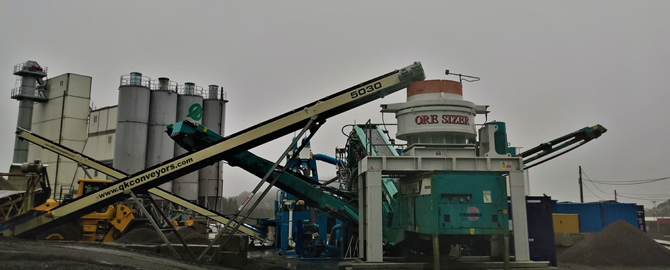
The Ølen Betong site at Fana, Bergen, utilizes tunnel excavated rock from the Ryfast project in order to manufacture aggregates and artificial sand. The excavated tunnel rock initially has its shape improved followed by processing through a washing plant to remove the surplus fines. The granite/gneiss 0-16mm feed material is processed to produce 0-4mm, 4-8mm and 8-16mm products, which are then used to replace 75-100% of naturally occurring sand in order to manufacture shotcrete for use on the E39 highway tunnel project in Bergen. Already Ølen Betong has supplied 120,000m³ of ready-mixed concrete, 160,000m² tunnel lining elements and for the new Ulriken railroad tunnel, 80,000m³ of Ready-Mixed concrete as well as 3,892 invert sleepers.

The equipment used to process the aggregate is an Oresizer OM80 200Kw VSI (vertical shaft impact crusher), a Powerscreen Chieftain 2100 washing plant, 2 x CDE Hydrocyclones, CDE Evowash 151 and 71, and an Aquacycle A400 sediment tank. The setup has led to considerable environmental savings by greatly reducing the need for the shipping of natural sand into the concrete plant as well as reusing material resulting from tunneling construction.
Manufactured sand
From using the excavated tunnel material Ølen Betong has been able to reduce its reliance on naturally occurring sand. The manufactured material through this is in many ways an improvement on the naturally occurring sand. This is due to the fact that manufactured sand possesses significant benefits to the naturally occurring form as it originates directly from high quality virgin rock, and thus contains very few, if any, contaminants.

There are also significant advantages to be gained from the cubical shape of the end product produced during manufacture, which further provides advantages during cement and concrete manufacture, and hence benefits the construction process as a whole. This has proved especially valuable in the production of concrete products, as during the concrete production process there needs to be very little altering of the amount of water or cement required during specific stages, thereby making the process far more cost effective.
This improved manufactured sand is produced with the 0-200mm source aggregate being initially fed into a Powerscreen Maxtrack 1500 cone crusher. The resulting material is then fed into a VSI (in this case, a UV320 from Sandvik Mining and Rock Technology), before being screened by a McCloskey mobile plant into 0-8mm and 8-16mm products.
About Roger Murrow: Roger is an editorial contributor to the FocusOn Group to offer interviews, insights and comments on the latest developments in the industry. Roger has been involved in the quarrying, tunneling, construction, demolition and recycling industries for 25 years. His experience involves senior marketing roles in a number of manufacturers, then as the founder of internationally renowned PR Consultancy MMC 2100 Ltd. In recent years, he has been using this experience to write articles for numerous international magazines on a variety of industry subjects.