
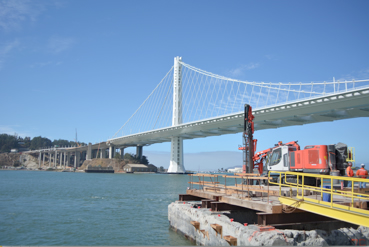
Eighty years after piers were constructed in San Francisco Bay to hold up the eastern span of the San Francisco-Oakland Bay Bridge, a specialized contractor is preparing to blast its sturdy footings. Demolishing the reinforced concrete piers is the final step in the removal of the nearly 2 mile long span. In order to accomplish this complex task in an environmentally friendly way a Ranger DX800 drill rig from Sandvik Construction has been working on site, impressing with its customer focused and highly productive features.
The San Francisco-Oakland Bay Bridge has already has been replaced by an adjacent $6.4 billion structure that claims the title of world’s widest bridge. While the new bridge is impressive, so is the demolition job being undertaken by Florida contractor Contract Drilling & Blasting LLC. The company’s challenging task is to make a pier disappear cleanly beneath the bay bottom without disturbing the bay’s avian and marine life.
The contractor is tasked with drilling 159 holes in Pier E3, chosen to be the demonstration pier for explosives demolition. Cartridge charges will be placed in the holes at several levels and the pier imploded without negative impacts to marine life or environment. Environmental concerns are magnified because this is California’s first major blasting demolition in water. This means that the dust and slurry created by concrete dust emanating from the demolition cannot be allowed to degrade water quality.
In order to deal with this potential problem a system of garbage cans were put around the drill, and all drilling residue and cuttings were collected and placed in a covered container exclusive for aggregates for hauling to shore. It was essential that no leaks or blown hoses occur as this could lead to contamination of the water. Clearly, Contract Drilling & Blasting had a big job on its hands.
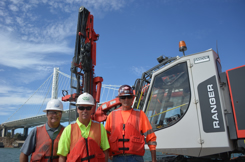
The job was however approached with confidence as the contractor has done similar work before, though perhaps not under such tight environmental restraints. The company has developed a first class reputation in its field and now travels the world undertaking specialized blasting and demolition projects. This includes the demolition of marine structures and bridge superstructures, as well as other underwater blasting projects. Blasting specialist for the company, Ken Tully, has recently successfully demolished bridge piers in British Columbia, Canada, which were diligently monitored for any negative environmental impact and is the Controlled Blasting Specialist for the E3 demolition project. Tully was responsible for designing the blast, overseeing the drill operations and conducting the blasting operations.
This emphasis on employee expertise on the project saw Danny Deskins drill the holes in the demonstration pier. Though Pier E3 was the first pier he worked on, Danny is a 26-year veteran of precision drilling, and was able to meet the challenges head on. His expertise proved vital as the structure’s vertical rebar and cross-ties tested both machine and operator, but were drilled through successfully. Other surmounted challenges included jagged surfaces on the tops of walls and soft spots in the concrete, both of which can send a drill bit skittering one way or the other.
The drilled pier is 80 feet wide by 130 feet long and stretches downward 289 feet from its cap, with the last 180 feet being into the muddy bottom of the bay. Beneath the pier’s cap is a supporting grid honeycombed with voids. Horizontal cross-sections periodically intersect with three-foot-thick reinforced concrete walls. Holes were drilled into each of the three-foot interior walls as well as in four-foot-thick exterior walls. The holes were drilled in two depths—64 feet and 86 feet—in a pattern designed to neatly capture the exploded and inward-collapsing material at the bottom of the pier’s footprint. More than 558 individual electronic detonations will be separately initiated on the multiple decks, with an expected total time of 4.6 seconds.
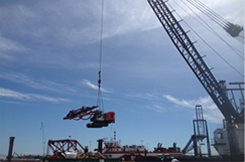
In order to accomplish the demolition, a 37,000 lbs. drilling machine was crane-loaded onto a barge, floated to the pier, and offloaded atop it. When in place Deskins drilled 10 hours a day, five days a week. What made the drilling especially tricky, aside from environmental considerations, was the relatively thinness of the walls. Drilling a hole 2.75 inches in diameter for up to 86 feet with little to no deviation is not a simple task. “The trick was getting to the bottom of the hole without going out one side of the wall.” Deskins says.
Tully specifically chose a Sandvik Ranger DX800 drill rig for the challenging job. “I wanted this machine. I have used similar Sandvik equipment on other projects and was very satisfied. The accuracy and trueness of the holes was fantastic.” Aggregate Crusher Specialists, the Sandvik Drilling and Stationary Crushing and Screening equipment dealer for Nevada and California, promptly supplied the machine for rental when Contract Drilling & Blasting needed it. ACS President, Mike Murphy, states: “Time is of the essence in this industry; we strive to be able to supply the right equipment and the best service at the right time. Barry Wells, our Drill Specialist, was present on-site the first few days of the drill arriving to the pier and supplied the technical support during the project.”
Tully has worked around Sandvik drilling rigs for 20 years—including with predecessor Tamrock units—and says he always has been impressed with their productivity. The blasting specialist believes three features on the Ranger DX800 were critical on drilling Pier E3. One was the rig’s reach, which in the limited pier area can be very difficult and sometimes up to 2 to 3 feet. Another was its ability to revolve its superstructure up to 180 degrees and drill multiple holes from the same location. Those features minimize set-up time and, consequently, increase drilling time.
The other critical feature was Sandvik’s TIM5300 system, which measures depth and inclination to a high degree of accuracy. The enhanced drilling accuracy of the TIM5300 was needed because the pier’s three-foot-thick walls were poured in place, sometimes in multiple pours, and were not expected to always run true. Guided by the system, combined with Tully’s selected drill string and operator, the Ranger DX800 proved productive despite the irregular material and untrue structuring. “There were lots of surprises and adjustments to make, but we made them successfully,” says Tully, who adds: “This project was undertaken in a controlled drilling atmosphere rather than a production drilling atmosphere. I would rather take an hour on a single hole than quickly drill a bad one.”
Deskins says he couldn’t imagine having tackled the task with any other drill. He calls the Ranger DX800 an operator-friendly machine, stating: “The Cadillac of the drilling world. You really need to be precise and pay attention to the hole you are drilling, but the cabin is comfortable and you don’t have to stretch a long way. The TIM5300 system will keep up with the penetration rate, which makes it quicker for me to go through from one hole to the next. Electronically and hydraulically it is a great machine. Additionally, the pier environment is a small space; you can get lots of people on the pier around you but the cameras in the cabin allow me to see everything around me. Sandvik has taken into consideration the comfort of the operator, which makes the job a lot easier for me.”
Sandvik Construction Area Sales Manager Avery Martin says such compliments from operators are not rare. “The operator is given great visibility of the hole they’re drilling. Rod-changing is done with the left hand, and joy-stick drilling and boom control with the right. All pressure gauges are in the operator’s line of sight as they look at a hole. All in all, the cabin is designed so an operator can focus 100% on drilling. From a hydraulic point of view, one feature that makes the job easier for the operator is the Rock Pilot+ control system. It measures the hardness of the material and adjusts accordingly in order to get a straight hole.” And as Deskins puts it: “Anything that is easier to run for the operator will increase your productivity.”
The estimated time needed to actually destroy the pier after it has been drilled and laced with electronically sequenced explosives is less than six seconds. Contract Drilling & Blasting will be setting up the blast in November 2015. The month was selected because demolition during the period poses the least risk to San Francisco Bay’s fish and wildlife populations, including porpoises, sea lions and seals. Delicate tasks like this one are doable because drilling specialists and Sandvik continue to refine the machines that can do the job.